Understanding the 4 Main Types of Bariatric Surgery and Their Nutritional Demand
Deciding to undergo bariatric surgery is a significant step toward reclaiming your health. But the journey doesn't end in the operating theatre.

A crucial part of your long-term success lies in understanding how your body changes and what it needs to thrive. While there are several types of bariatric surgery, they are not all the same, and neither are their nutritional demands. Your post-surgery nutrition plan is not a one-size-fits-all solution.
Bariatric procedures work through two main mechanisms: restriction (limiting the amount of food that can be eaten) and malabsorption (reducing the calories and nutrients that the body can absorb). The specific type of surgery you have determines the degree of each, which in turn dictates your unique nutritional risks and supplementation needs. Failing to match your multivitamin to your procedure can lead to serious health consequences. This guide will walk you through the main types of bariatric surgery, their specific nutritional demands, and why a specialised multivitamin is your most important tool for long-term health.

The Gastric Bypass, or Roux-en-Y, is considered the ‘gold standard’ of weight loss surgery. It works by creating a small stomach pouch and then rerouting a section of the small intestine to connect directly to this new pouch. This ‘bypass’ means food skips a significant portion of the stomach and the first part of the small intestine (the duodenum).


While highly effective for weight loss, this rerouting has profound consequences for nutrient absorption. The duodenum and upper jejunum are where your body absorbs most of its crucial vitamins and minerals. By bypassing this section, you create a high-risk environment for severe deficiencies.
Iron and Folate: The primary site for iron absorption is the duodenum. Bypassing it makes iron deficiency and subsequent anaemia extremely common.
Calcium: Like iron, calcium absorption is heavily dependent on the duodenum. A bypass significantly increases the risk of bone density loss and osteoporosis.
Vitamin B12: B12 requires stomach acid and a protein called intrinsic factor to be absorbed. The smaller stomach pouch produces less acid, and the bypass limits its chance to mix with food, making B12 deficiency almost inevitable without proper supplementation.
Gastric Bypass surgery dramatically reduces your ability to absorb vital nutrients, especially iron, calcium, and vitamin B12.
A standard over-the-counter (OTC) multivitamin is simply no match for the malabsorption caused by a Gastric Bypass. These generic supplements contain inadequate dosages, poor bioavailability, and incomplete formulations.
For gastric bypass patients, a specialised bariatric multivitamin is essential. These formulas provide:
Choosing a generic supplement after a gastric bypass is a gamble with your health. The best multivitamin for gastric bypass patients is one specifically designed for this high-risk, malabsorptive environment.

The Sleeve Gastrectomy, or gastric sleeve, is a primarily restrictive procedure. It involves removing about 80% of the stomach, leaving behind a narrow, banana-shaped ‘sleeve’. This dramatically reduces the amount of food you can eat at one time, helping you feel full much faster.

Because there is no intestinal bypass, malabsorption is less severe than with the Gastric Bypass. However, significant nutritional risks still exist.
Reduced Intake: The most obvious challenge is the sheer reduction in food volume. It becomes challenging to get all the necessary nutrients from your diet alone.
Lower Stomach Acid: The portion of the stomach that is removed (the fundus) is a major producer of stomach acid and intrinsic factor. As with the bypass, this reduction directly impacts your ability to absorb Vitamin B12.
Rapid Transit: Food moves through the new stomach sleeve more quickly, reducing the time available for nutrients to be broken down and absorbed.
For sleeve patients, the key to avoiding deficiency is strict compliance and choosing supplements with highly bioavailable forms. While your absorption isn’t as impaired as that of a bypass patient, it is still compromised. A generic multivitamin may not be potent enough to make up for the drastically reduced food intake.
A bariatric-specific multivitamin ensures you receive the necessary doses of B12, iron, and other key nutrients in a form your body can easily absorb, thereby safeguarding your health as you lose weight. With a Gastric Sleeve, reduced food intake and lower stomach acid make vitamin and mineral deficiencies a real risk.
With a Gastric Sleeve, reduced food intake and lower stomach acid make vitamin and mineral deficiencies a real risk; consistent use of a specialised multivitamin is key to staying healthy.
The Duodenal Switch (DS) and its modern variation, the SADI-S, are the most potent types of bariatric surgery. They combine a sleeve gastrectomy with a significant intestinal bypass, creating a highly malabsorptive state. These procedures are typically reserved for patients with a very high BMI.

The trade-off for dramatic weight loss is the highest risk of nutritional deficiencies among all bariatric procedures. The extensive bypass dramatically limits the body’s ability to absorb nutrients, particularly fat-soluble vitamins and protein.
Fat-Soluble Vitamin Deficiency: The malabsorption of fat is extreme, leading to a high risk of deficiency in vitamins A, D, E, and K. These vitamins are crucial for vision, bone health, immune function, and blood clotting.
Protein Malnutrition: The shortened intestinal path makes it very difficult to absorb enough protein, which can lead to muscle wasting and other serious health issues.
Severe Mineral Deficiencies: The risks for iron, calcium, and zinc deficiencies are exceptionally high.
Patients undergoing a DS or SADI-S require the most aggressive and comprehensive supplementation regimen. A standard multivitamin is dangerously inadequate. Patients need a robust, bariatric-specific formula that delivers high doses of all essential nutrients, particularly the fat-soluble vitamins.
Furthermore, post-operative swallowing difficulties can be an issue. In these cases, the form of the supplement becomes critical. Chewable, liquid, or small, easy-to-swallow capsules are essential to ensure compliance and absorption can begin.


This chart provides a clear overview of the risks associated with each procedure and the required supplement solution.
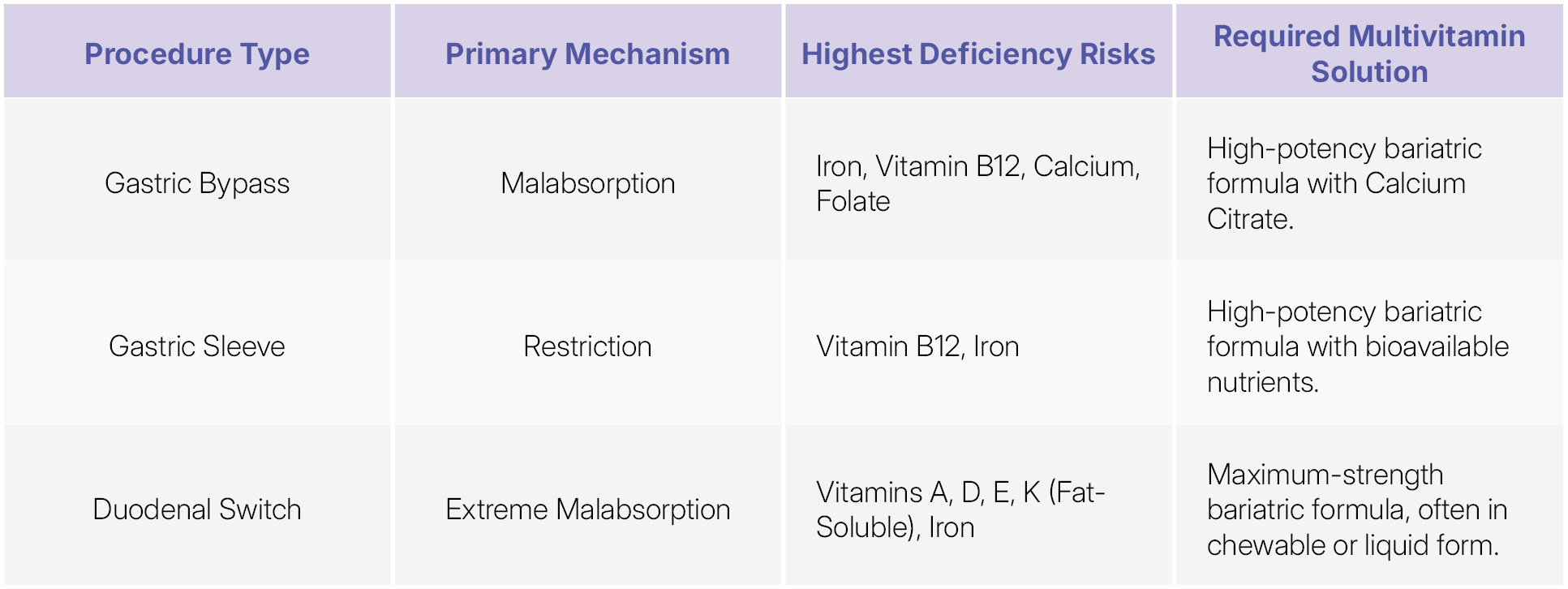
Find your surgery and its required vitamin solution.
Understanding the unique demands of your specific bariatric procedure is the foundation of a successful and healthy weight loss journey. Nutrition is not one-size-fits-all, and your choice of multivitamin will be one of the most important decisions you make for your long-term well-being. Generic, over-the-counter products are not equipped to handle the complex nutritional challenges posed by bariatric surgery.
A complete, physician-formulated bariatric multivitamin is designed to provide the right nutrients, in the proper doses and forms, to meet the specific demands of your procedure. Investing in a high-quality supplement is investing in your future health, energy, and vitality.
Take the guesswork out of your post-surgery nutrition. Explore BariLife-Lite’s range of bariatric multivitamins in Australia, expertly designed to provide the specialised support your body needs to thrive after surgery.
*These statements have not been evaluated by the TGA or a Bariatric specialist. The information provided is not intended to replace medical advice provided by a Medical professional. This product is not intended to diagnose, treat, cure, or prevent any disease. Always consult your healthcare provider before starting any supplement regimen.

Your health shouldn’t be left to chance, especially after bariatric surgery. At BariLife-Lite, we offer a range of products designed specifically for the needs of bariatric patients. From multivitamins to protein shakes, our supplements are tailored to promote optimal absorption and nutrition without compromise.
BariLife Just One-Lite makes supplementation effortless with a single daily dose, helping you avoid deficiencies and maintain your health.
Start your post-bariatric nutrition journey with the confidence and tools you need to succeed. Shop Now to discover our full range of products and begin your path to long-term wellness today.